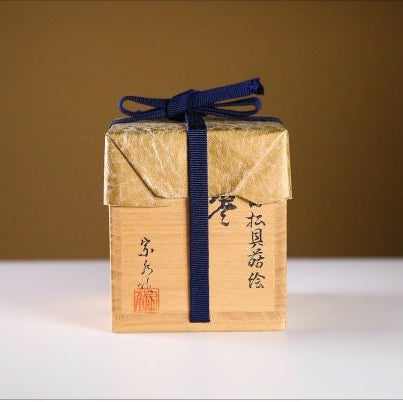
Wajima raden mirugai natsume with mother-of-pearl inlay Sea Pen & Shell design (Mirugai natsume) by Shimizu Sōsui
Wajima raden mirugai natsume with mother-of-pearl inlay Sea Pen & Shell design (Mirugai natsume) by Shimizu Sōsui
Couldn't load pickup availability
An exceptional natsume (棗) by the Wajima lacquer master Shimizu Sōsui (清水宗翠), titled Mirugai (海松貝), an elegant elongated shell from Japanese waters. The motif depicts a tranquil coastal landscape where waves, seaweed, and shells merge in refined raden (mother-of-pearl) and maki-e (gold powder), a classic theme in Japanese decorative art that symbolizes the richness and dynamism of the sea.
Motif
The deep black lacquer ground is full and glossy. Soft, undulating lines suggest the rhythm of the sea, while scattered shells, including the distinctive elongated mirugai, lie as subtle accents in the landscape. The composition is deliberately asymmetrical and exudes tranquility. A misty, slightly grainy effect in the background adds depth and evokes sand disturbed by water.
Accents of raden are incorporated into the surface: inlaid mother-of-pearl that shows a soft blue-green sheen in the light. This material, originating from shells, reinforces the theme of the artwork in an almost poetic way, where image and material merge. The lid features a calmer composition of loose shells and a slender seaweed branch, like a stillness after movement.
The interior is exceptionally finished in a soft metallic lacquer with silver and gold tones. This subtle shimmer deviates from the more common gold lacquer and points to sophisticated atelier technique and attention to detail.
Symbolism
In Japanese decorative art, the marine motif refers to infinity, abundance, and the untamed power of nature. Shells are classic symbols of happiness and harmony, rooted in a coastal aesthetic that has held a firm place in decorative imagination since the Heian period. Combining different shells and seaweed in one composition is a reference to mono no aware: the beauty of diversity and transience, animated by the eternal movement of water.
Craftsmanship
Wajima is known for a lacquer tradition where dozens of layers of urushi are applied by hand, each time dried and smoothed, before the surface achieves its characteristic depth. Shimizu Sōsui worked within this tradition, creating objects for the tea ceremony throughout his life, where each natsume must be both beautiful and comfortable to hold.
On this piece, two techniques have been combined, each of which alone requires considerable time and practice. In raden, thin pieces of mother-of-pearl are inlaid into the lacquer surface. In maki-e, gold powder is sprinkled onto wet lacquer and applied with great precision. The fact that both techniques appear together here in one calm, balanced composition is unusual.
This natsume is heavier than average, a direct result of the thickness of the wood and the many layers of lacquer applied during the making process. The lid closes with a soft resistance and fits precisely, which can only be the result of careful handwork. That feeling in the hand tells more about the quality than any photograph ever could.
Object Data
- Maker: Shimizu Sōsui (清水宗翠, birth name Shimizu Shōzō, born 1921, Wajima)
- Title: Mirugai natsume, 海松貝蒔絵棗
- Technique: Maki-e (lacquer decoration with gold powder) and raden (mother-of-pearl inlay)
- Material: Lacquer wood (urushi), Wajima lacquer
- Diameter: 7.2 cm
- Height: 7.2 cm
- Weight: 63.7 g
- Period: Shōwa (approx. 1950-1980)
- Condition: Very good
- Accessories: Original tomobako with inscription 海松貝蒔絵 and seal of Shimizu Sōsui, tomonuno with seal, maker's introduction card
Signature and Maker
Shimizu Sōsui (清水宗翠) is the artist's name of Shimizu Shōzō, born in 1921 in Wajima, Ishikawa Prefecture, the historical center of Japanese lacquer art. Trained from a young age by his father Shimizu Shōsaku, he worked in an atelier in the city after his training before establishing himself independently in 1965. His work is rooted in the Wajima tradition and focuses particularly on objects for the chanoyu, the Japanese tea ceremony, with a special emphasis on the natsume. The combination of raden and maki-e, two techniques that each individually require great craftsmanship, characterizes the exceptional position Sōsui held within the Wajima school.