Wajima-nuri 輪島塗 natsume Sasa-tsuyu Hino Takuya maki-e natsume
Wajima-nuri 輪島塗 natsume Sasa-tsuyu Hino Takuya maki-e natsume
Couldn't load pickup availability
This refined natsume, crafted by Japanese lacquer master Hino Takuya (日野拓也), is an example of high-quality Wajima-nuri lacquerware from Ishikawa. As a traditional matcha tea caddy, the natsume is used in the Japanese tea ceremony for storing and serving powdered tea. In this work, functionality and aesthetics converge: a timeless object where the depth of urushi lacquer and the subtlety of the design reflect the essence of Japanese craftsmanship.
Motif
The deep black urushi lacquer forms a silent, reflective base over which a layered composition of bamboo leaves unfolds. The leaves are not uniform: some are rendered in warm gold with finely incised veins, while others glow in red-orange tones through the use of aka-fun, reddish gold powder that gives a depth as if the leaves are illuminated from within. Interspersed among them, some leaves are inlaid with raden (螺鈿): pieces of mother-of-pearl that iridesce blue, green, and purple depending on the light. Small silver dots, tsuyu, or dewdrops, are scattered over the whole, completing the image of an early morning.
The decoration is deliberately restrained in composition but rich in detail. The leaves appear to float over the black surface, light and moving, while the changing gleam of gold, red, and mother-of-pearl makes the object appear differently with every change of light. It is precisely this layering that makes this piece powerful: it reveals itself slowly, with repeated viewing.
Symbolism
In Japanese culture, sasa (笹, bamboo leaves) symbolizes resilience and flexibility. It bends with the wind without breaking. Within the context of the tea ceremony, this refers to inner peace, adaptability, and presence in the moment.
The tsuyu (露, dew) sprinkled as silver dots over the leaves adds a second layer of meaning: dew in Japanese aesthetics is a symbol of transience and freshness simultaneously. It appears only in the early morning and vanishes with the light, an image closely aligned with the spirit of wabi-cha. The combination of bamboo leaves and dew is a classic autumn morning motif, 笹露 (sasa-tsuyu), which unifies freshness, stillness, and the passage of time in a single image.
The three materials reinforce this together: the gold of the maki-e refers to warmth and maturity; the red-orange aka-fun evokes the color of autumn leaves; and the cool, constantly changing light of the raden adds something fleeting, like light that falls differently every second.
Object details
- Maker: Hino Takuya (日野拓也, Wajima)
- Title: Sasa maki-e natsume (笹蒔絵棗)
- Type: Ōnatsume (usucha tea caddy)
- Technique: Maki-e (蒔絵) with raden (螺鈿, mother-of-pearl)
- Material: Wood with urushi lacquer (Wajima-nuri / 輪島塗)
- Diameter: ≈ 7.5 cm
- Height: ≈ 7.5 cm
- Condition: New condition
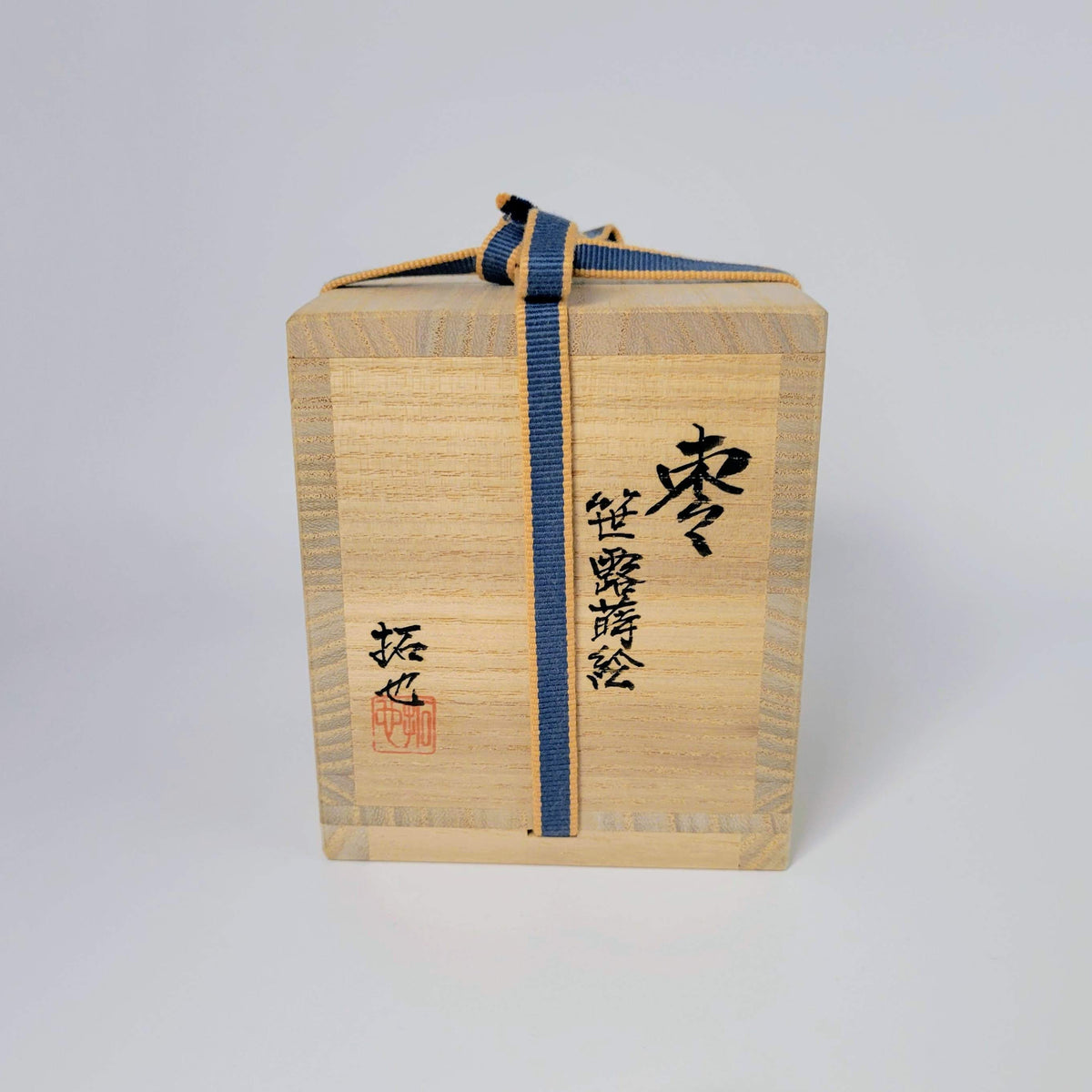
- Accessories: Original tomobako (共箱) with maker's signature, shiori (栞, documentation), Wajima quality card
Signature and maker
Hino Takuya (日野拓也) is a contemporary maki-e craftsman from Wajima, a city considered the heart of Japanese lacquer traditions. He trained under a recognized master and developed into an independent artist from the end of the Shōwa period (1989). His work is characterized by a strong anchoring in classical Wajima techniques, built in multiple layers of urushi, reinforced with jinoko, combined with a refined, contemporary aesthetic.
Hino Takuya is not among the big names found in museums, but he belongs to the group of artisans who keep the Wajima tradition alive and pass it on. His pieces can be found at Kadochi Shikkiten (角知漆器店), a specialized lacquerware shop in Wajima that selects and offers work by local artisans. The shop is affiliated with the official Wajima industry organization, which further underscores the origin and quality of the work.
Wajima: City of Lacquer
Visitors to Wajima find themselves in the epicenter of a thousand-year-old lacquer tradition. The city on the Noto coast (Ishikawa Prefecture) still boasts hundreds of artisans who pass on their craft from generation to generation. The Wajima Kiriko Festival in August showcases the region at its most colorful, but those wishing to see the ateliers prefer to visit the city outside of peak season when workshops are open and the tranquility matches the nature of the craft.
The Wajima Shikki Kaikan (輪島漆器会館) houses a permanent collection that illustrates the layered construction of Wajima-nuri: from raw wood through dozens of layers of urushi to the finished surface. Beyond that, the small ateliers in the narrow streets of the old city are most revealing, where artisans work in silence on pieces that will not be finished for weeks or months.
The earthquake of January 2024 severely affected the Noto Peninsula, including Wajima. Many ateliers have since resumed work, and local and national support programs are specifically aimed at preserving the lacquer traditions. A purchase of Wajima-nuri is thus also a contribution to the survival of a living heritage.
Share