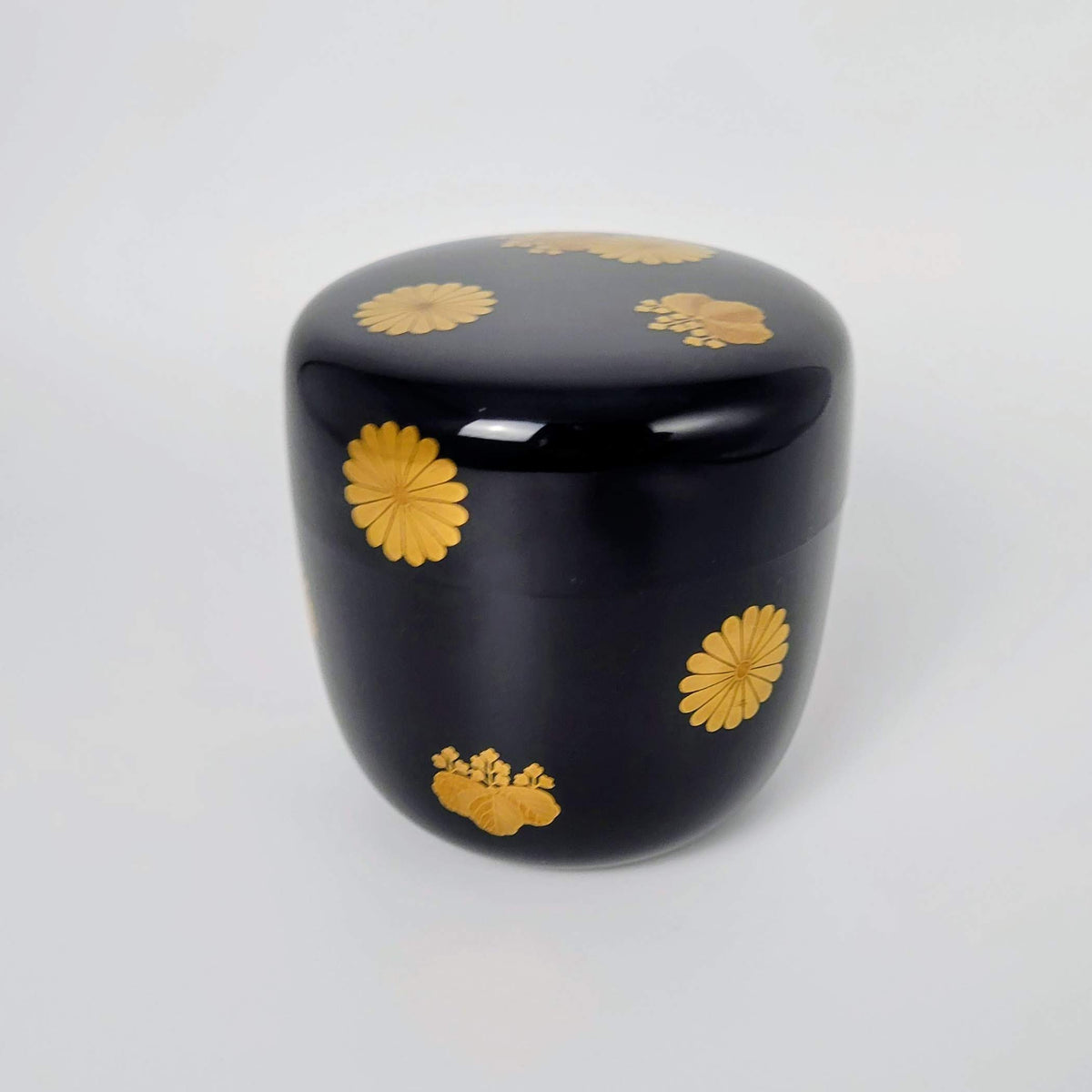
Kōdaiji (高台寺) Maki-e Natsume by Tasaki Shōichirō (田崎昭一郎)
Kōdaiji (高台寺) Maki-e Natsume by Tasaki Shōichirō (田崎昭一郎)
Couldn't load pickup availability
In 1606, Nene, the wife of the great general Toyotomi Hideyoshi (1537–1599), had a temple built in Kyoto in memory of her husband. The Kōdaiji (高台寺) temple is hidden in the hills of Higashiyama, a place of quiet mourning and great beauty. The masters who worked for that temple developed a lacquer style that would bear its name: gold on deep black urushi, asymmetrical compositions, refinement as a form of remembrance. Four centuries later, this tradition is still passed down, and this natsume is a silent bearer of it.
Motif
The decor is executed in fine maki-e technique (蒔絵), where gold powder is built up layer by layer in the still-wet urushi. The chrysanthemums are depicted with clear, crisp lines, while the paulownia leaves show subtle texture details that become visible depending on the light. Against the deep black lacquer, a powerful contrast emerges between simplicity and luxury, a characteristic feature of high-quality tea ceremony objects.
Symbolism
The motif combines two of the most prestigious symbols from Japanese court and art tradition. The chrysanthemum refers to elegance, durability, and the imperial culture of Japan. The paulownia, as goshichi-kiri (五七桐), the family crest of the Toyotomi clan and later also a state symbol, carries a historical weight that connects the object to the golden period of Momoyama aesthetics.
Object details
- Maker : Tasaki Shōichirō (田崎昭一郎)
- Master : Ichigo Icchō (一后一兆, 1898–1991)
- Style : Kōdaiji maki-e (高台寺蒔絵)
- Technique : Maki-e (蒔絵)
- Decor : Chrysanthemum and paulownia (kiku & kiri)
- Material : Wood with urushi lacquer
- Height : 7cm
- Width : 7 cm
- Origin Wajima, Japan
- Period : Shōwa / early Heisei
- Condition : Excellent
Tomobako and signature
The original tomobako bears the inscription: 高台寺蒔絵 棗 東 — Kōdaiji maki-e natsume Higashi. The object is accompanied by original Japanese workshop documentation detailing exhibitions, artistic registrations, and biographical information about the maker, a unique detail rarely preserved with this type of object.
Tasaki Shōichirō
Tasaki Shōichirō (田崎昭一郎) was a Japanese lacquer artist from Wajima, Ishikawa Prefecture, a region internationally known as one of the most important centers of high-quality Japanese urushi lacquerware. He was trained under the renowned master Ichigo Icchō (一后一兆), one of the leading maki-e artists of the 20th century whose work was selected for the Nitten, among others, and who was appointed an honorary citizen by Wajima.
From this traditional master-apprentice lineage, Tasaki developed into a recognized artist. According to the accompanying workshop documentation, he exhibited at the Nitten (日展) and other national Japanese art and craft exhibitions. He was also a member of the Nichikōbikai (日工美会) and involved with the Wajima Lacquer Art Technical Training Institute, where he contributed to the training of new generations of lacquer artists.
Visit Kōdaiji Temple
Those wishing to visit the temple itself should preferably do so after sunset. Kōdaiji, literally "High Terrace Temple", has grown into one of the city's most iconic evening attractions. Three times a year, in spring, summer, and autumn, the gardens and historic buildings are illuminated in an interplay of traditional architecture and modern light. The highlight is a projection mapping show where the rock gardens and main buildings of the temple serve as a canvas for a light spectacle. The place where Nene mourned Hideyoshi is thus re-enchanted every season.
Share