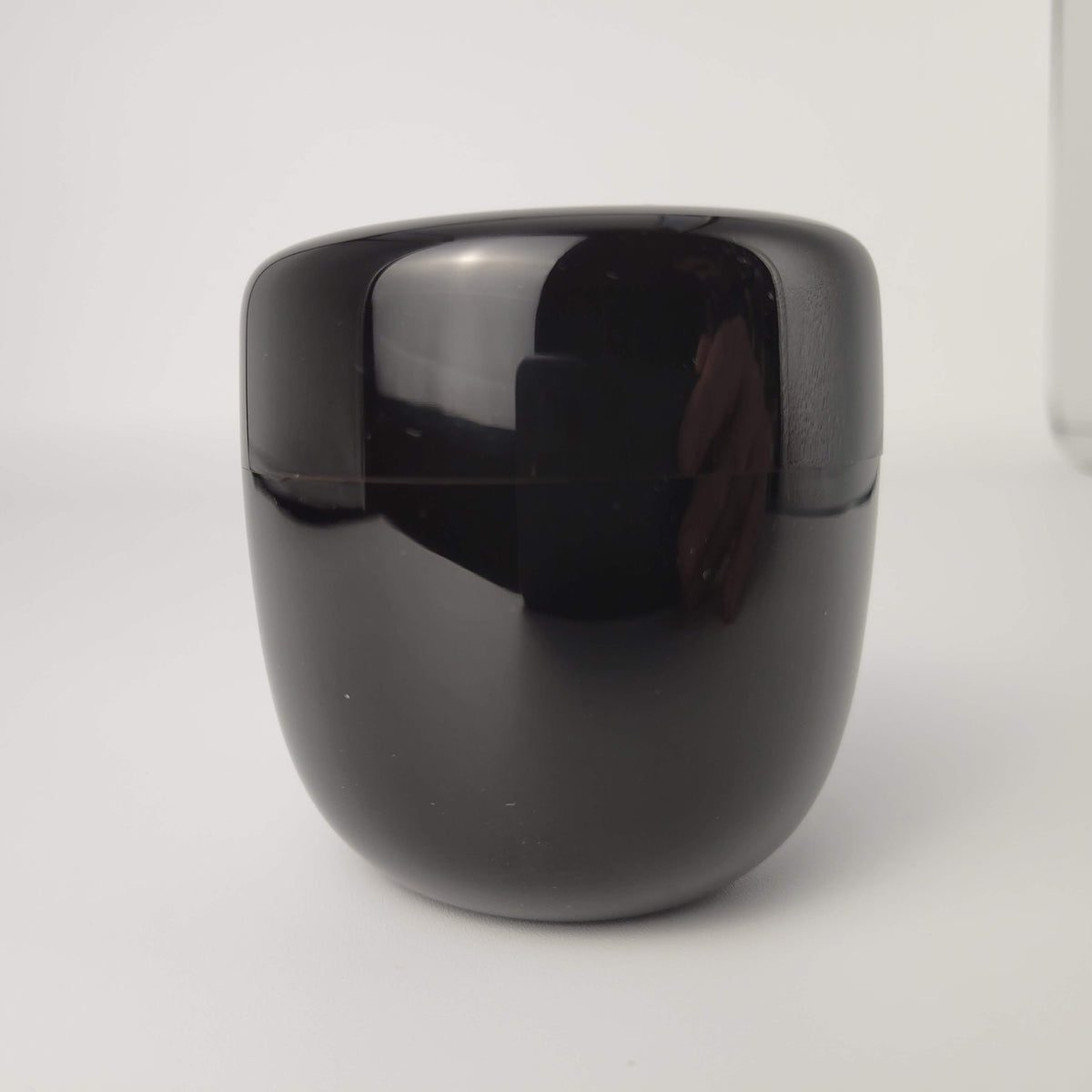
An elegant Japanese natsume (棗) by lacquer artist Tsukamoto Noriyoshi (塚本規義), crafted in the Yamanaka lacquer tradition. Against a deep black lacquer ground, two geese fly in gold maki-e. Inside the lid, a refined depiction of Japanese autumn grasses unfolds.
Motif
The two geese fly close together, their wings spread wide. The golden imagery contrasts with the glossy black lacquer. The composition is simple and intentionally leaves much space open. On the inside, another image appears: slender grasses and swaying plumes, executed in fine gold and dark lines on a softly shimmering surface. It is a subtle detail that only becomes visible when the lid is opened. Together, both depictions form an autumn landscape, without the landscape itself being portrayed.
Symbolism
The wild goose, kari (雁), is a classic symbol of autumn in Japanese art. Its annual migration serves as a reminder of the passing of the seasons, of farewells and returns, and of the continuous movement of nature. The ornamental grasses, susuki (薄), belong to the seven traditional autumn plants of Japan. Their fragile plumes move with the wind, reminding us of the beauty of the temporary. Here, the depiction touches upon mono no aware: the quiet realization that it is precisely transience that makes something beautiful. The spirit of wabi-sabi is also recognizable in the simplicity of the composition, the open space, and the attention to small, fleeting moments.
Object Details
- Maker: Tsukamoto Noriyoshi (塚本規義)
- Origin: Yamanaka, Ishikawa, Japan
- Object: Chūnatsume (中棗), medium-sized natsume
- Motif: Flying wild geese and Japanese autumn grasses
- Technique: Maki-e on black lacquer
- Condition: Older object with minor traces of age and use;
- Accessories: Matching wooden box with inscription and signature
Tsukamoto Noriyoshi
Tsukamoto Noriyoshi (b. 1963) was born in Yamanaka, a region with a long tradition of woodturning and lacquer art. He trained under experienced lacquer artists and developed into a specialized maker of maki-e objects for the Japanese tea ceremony. His work is characterized by traditional nature motifs, careful compositions, and a refined application of lacquer decoration. He has received regional recognition for his craftsmanship, including an award for traditional craft art in Ishikawa. This natsume demonstrates his feel for the Japanese seasons. Not through an exuberant depiction, but through two birds and a few blades of grass that together evoke an entire landscape.