Japanse natsume Chiku maki-e 竹蒔絵 Kōgetsu
Japanse natsume Chiku maki-e 竹蒔絵 Kōgetsu
Couldn't load pickup availability
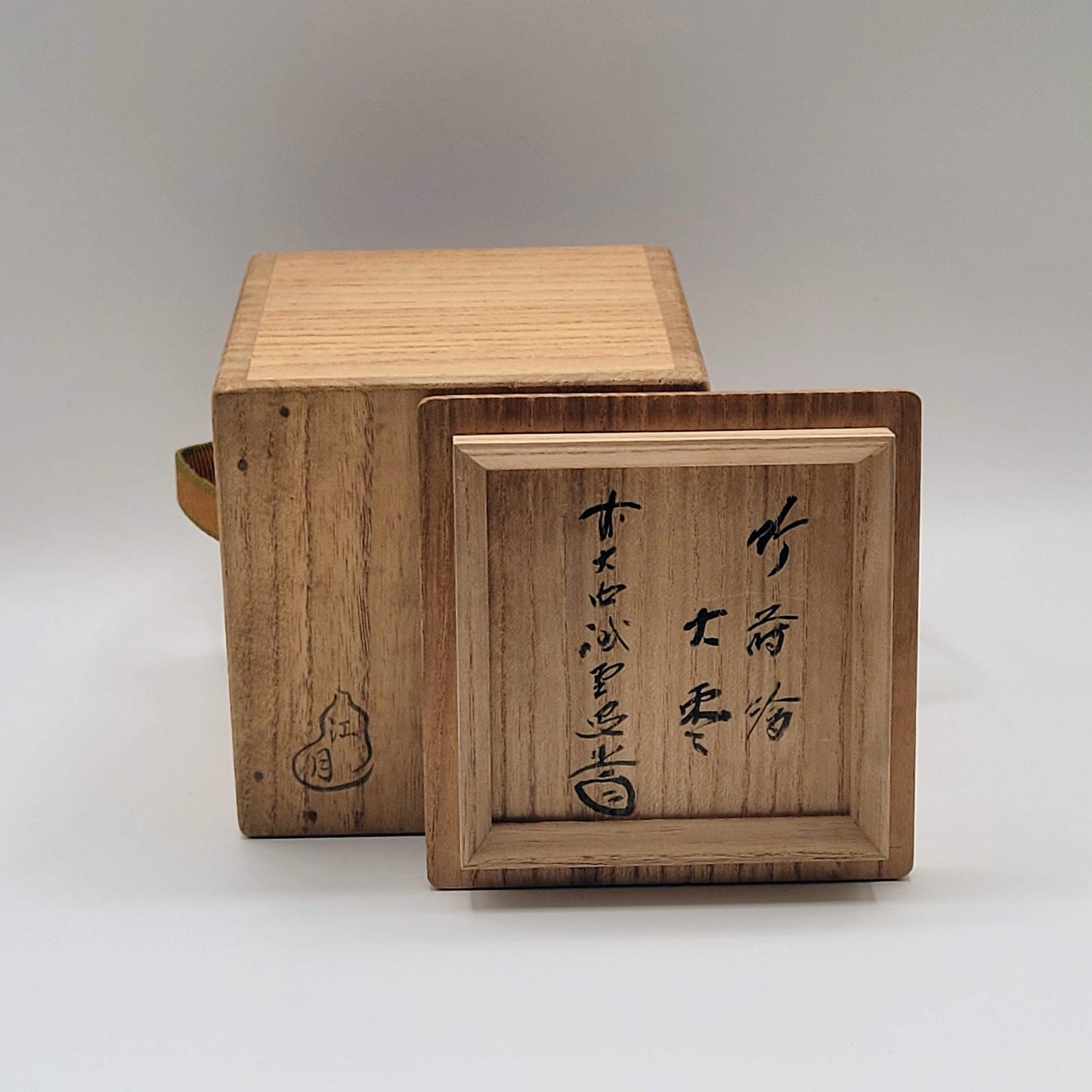
This remarkable natsume was created by lacquer artist Kōgetsu (江月). The piece bears a handwritten endorsement inside the lid of the tomobako known as a kakitsuke (書付) by Fujii Kaidō, the 515th abbot of Daitoku-ji Temple in Kyoto, one of the most authoritative names in the world of the Japanese tea ceremony.
Motif
Against the deep black lacquer ground, delicately executed gold and silver maki-e depict the branches and leaves of bamboo. The composition appears dense and lifelike, as if a breeze were passing through the foliage. The lines are extremely fine and reveal a master’s hand: slender shoots alternate with full leaves that spread gracefully in all directions.
Symbolism
In Japanese culture, bamboo is one of the “Three Friends of Winter” (saikansanyū, 歳寒三友), together with pine and plum. It symbolizes strength, flexibility, and resilience: bamboo bends in the storm but does not break. Within the tea ceremony, bamboo represents humility and restraint, precisely the qualities sought by the master of wabi-cha.
The Kakitsuke of Fujii Kaidō
A 書付 (kakitsuke) is a handwritten inscription by an authoritative tea master or temple abbot on the tomobako, formally acknowledging the excellence of the object.
Fujii Kaidō (藤井誡堂, 1898–1984) was the 515th abbot of Daitoku-ji, historically the spiritual heart of the Japanese tea ceremony, and also served as head priest of the Sangen-in sub-temple.
After the Second World War he played a key role in the reconstruction of Daitoku-ji and guided Kyoto potters in the revival of historical ceramic styles. He himself produced tea bowls, tea scoops, and calligraphy, and was regarded as one of the most respected and beloved abbots in the world of the tea ceremony. His kakitsuke was not granted routinely, each object was judged with genuine expertise and deep understanding. When his name appears on a tomobako, it signifies that the piece has passed a discerning and authoritative evaluation.
Object Details
- Maker: Kōgetsu (江月) — maki-e lacquer artist
- Title: Chiku maki-e Ōnatsume (竹蒔絵大棗)
- Technique: Gold and silver maki-e on black urushi lacquer
- Material: Lacquered wood (urushi)
- Diameter: ≈ 7.2 cm
- Height: ≈ 7.3 cm
- Condition: Very good; light signs of use, no scratches on the lacquer
- Accessories: Original tomobako with seal of Kōgetsu and kakitsuke
- Lid: red kao signature
- 造 (tsukuru) — “made by”
- 江 (kō) — first character of Kōgetsu
- Kakitsuke inscription:
- 大徳寺 — Daitoku-ji Temple
- 五百十五世 — 515th generation / abbot
- 黒巖 (Kokugan) and 誡堂 (Kaidō)
- Accessories: cloth with gourd emblem and the characters 江月.
Signature and Maker
The seal on the tomobako and the accompanying cloth display the characteristic gourd emblem (瓢箪) containing the characters 江月, the personal seal of Kōgetsu. The name 江月 literally means “river moonlight.” This imagery subtly reappears in the work: among the golden bamboo leaves, several leaves are intentionally rendered in silver, evoking moonlight gliding across the branches at night.
The accompanying kakitsuke by Daitoku-ji abbot Fujii Kaidō makes this piece not only artistically refined but also exceptionally significant within the ceremonial world of the tea tradition.